Observer's guide
About Antennae Galaxies
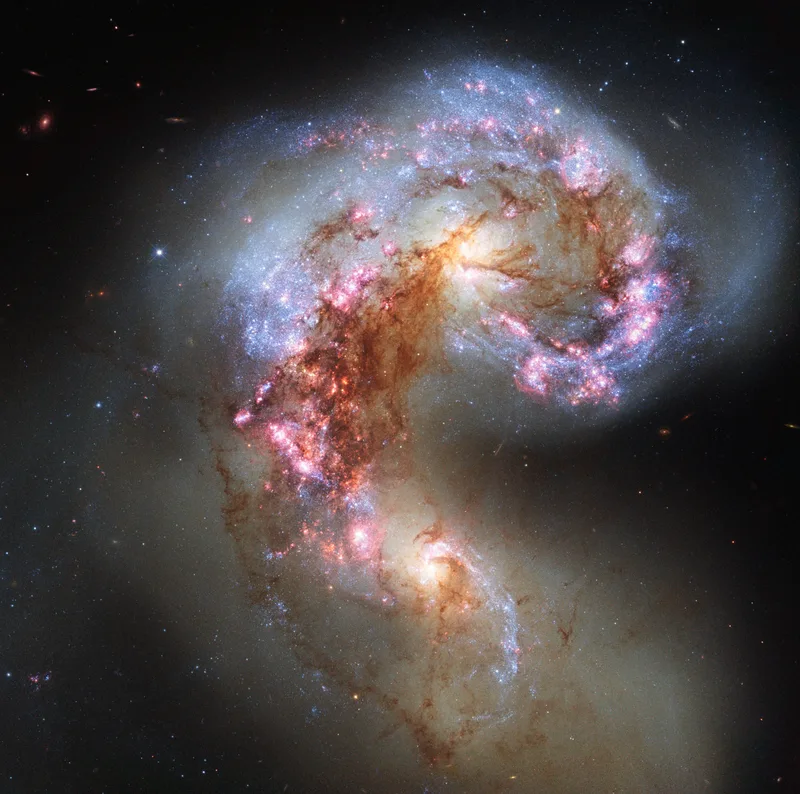
NGC 4038 is the northern and larger half of the Antennae Galaxies, a famous colliding pair in Corvus about 83 million light-years away. Listed as Caldwell 60, it is tangled together with NGC 4039 (Caldwell 61). The collision has thrown out two long tidal tails, the antennae of the name, and set off intense bursts of star formation in both galaxies.
Observing tips
From Gienah (Gamma Corvi), the northwestern star of the Corvus quadrilateral, move about 3.5° west-southwest. Binoculars will not show it. A 100 mm scope at 80x shows a faint, irregular glow, and you will struggle to separate it from NGC 4039. In a 200 mm or larger instrument under dark skies the pair takes on a lopsided comma or heart shape, with NGC 4038 the brighter, broader part. The tidal tails are a photographic target only. From 52°N it transits at about 19°, so March and April evenings with a low, clear southern horizon are best.
Because it is faint, use a larger aperture where possible, avoid bright Moon conditions, and use averted vision.
What to expect
NGC 4038 is a disturbed spiral whose disk has been pulled apart by its encounter with NGC 4039. Gas compressed in the collision is forming huge young star clusters, and the system is a nearby example of the kind of merger that can eventually build an elliptical galaxy.
At 1000 to 1500 mm the pair and its tails fit in one frame. The tails are very faint, so plan on many hours of integration under dark skies to trace them.