Observer's guide
About Ghost of Jupiter
In a small telescope NGC 3242 looks like a pale blue-green disk about the size of Jupiter, which earned it the name Ghost of Jupiter. Caldwell 59 lies in Hydra, about 3,568 light-years away, and at magnitude 7.7 it is one of the brightest planetary nebulae in the spring sky. William Herschel discovered it in 1785, and its high surface brightness means it shows well even from suburban sites.
Observing tips
Find 4th-magnitude Mu Hydrae, west of the bowl of Crater, and move about 1.8° south. Binoculars show only a bluish star. In a 100 mm scope at 100x the disk is obvious and distinctly colored, and it takes high magnification well. A 200 mm telescope at 200x or more shows a brighter inner ring inside a fainter outer shell, and with steady air a hint of the central star. An OIII filter adds contrast but is not essential. From 52°N it transits at about 19°, best in February and March, so give it time to clear the murk near the horizon.
A small telescope under reasonably dark skies is a good starting point; use the live altitude chart to choose its highest point.
What to expect
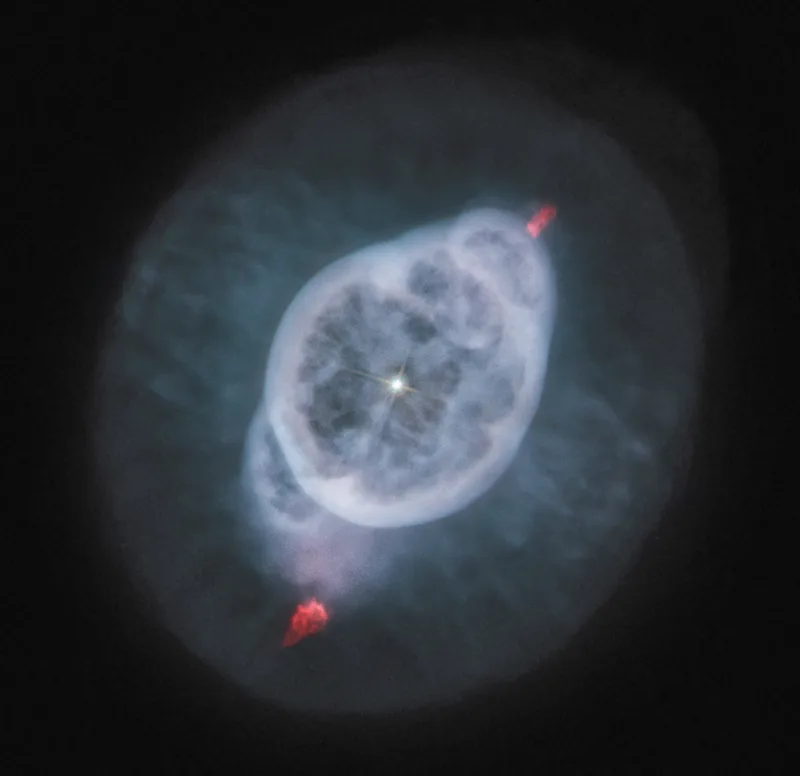
The nebula is the expelled outer layers of a Sun-like star, ionized by the hot white dwarf at its center. Its structure includes a bright inner shell, a fainter outer envelope and small knots of denser gas, known as FLIERs, along its long axis.
Small and bright, it needs 1500 mm or more of focal length and short subexposures to avoid burning out the core. Combining OIII and H-alpha brings out the blue-green inner shell and the faint outer halo.