Observer's guide
About Caroline's Cluster
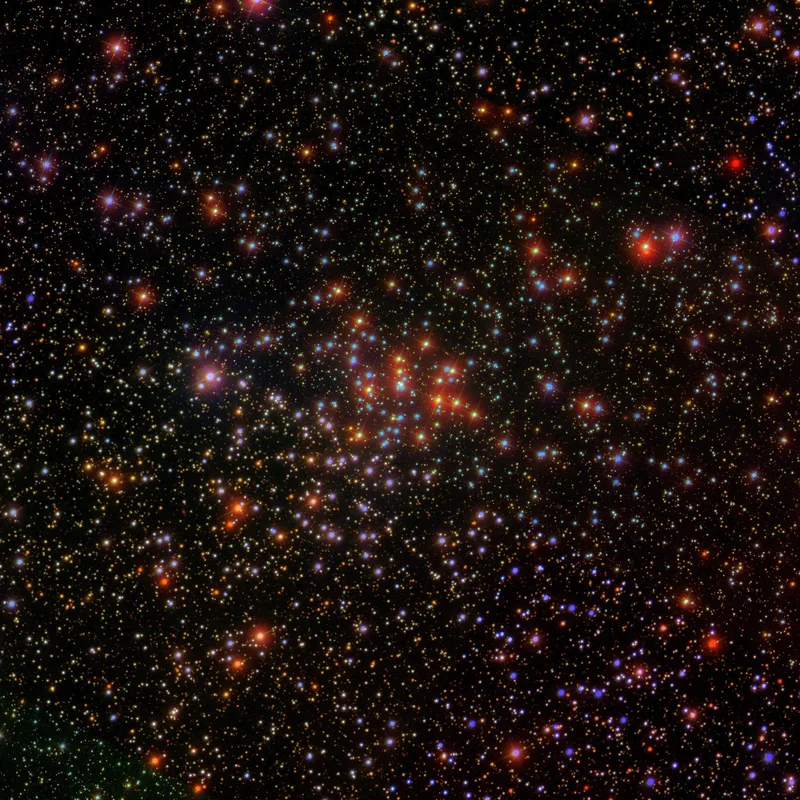
Caroline Herschel discovered this open cluster in 1783, and NGC 2360 (Caldwell 58) now carries her name as Caroline's Cluster. It sits in the eastern part of Canis Major, about 3,700 light-years away, in a rich Milky Way field. The cluster is old by open-cluster standards and holds many stars of similar brightness, which gives it an even, grainy look in the eyepiece.
Observing tips
Find Gamma Canis Majoris, the 4th-magnitude star about 4.5° east-northeast of Sirius, and move about 3.4° due east. At magnitude 7.2 the cluster shows in binoculars as a soft patch about 18 arcminutes wide. A 100 mm scope at 40x to 60x resolves dozens of faint stars, and a 200 mm instrument turns it into a dense, even swarm that fills a low-power field. It transits at about 22° from 52°N and is best in January, while observers in the southern US and the Southern Hemisphere see it much higher.
A small telescope under reasonably dark skies is a good starting point; use the live altitude chart to choose its highest point.
What to expect
NGC 2360 is a group of stars that formed together from one cloud and still move through space together. Because it is older than most open clusters, its most massive stars have already evolved, leaving red giants mixed among fainter main-sequence stars.
An 18 arcminute cluster suits 500 to 800 mm focal length. Aim for tight round stars and natural color balance so the yellow giants stand out against the blue-white members.