Observer's guide
About Barnard's Galaxy
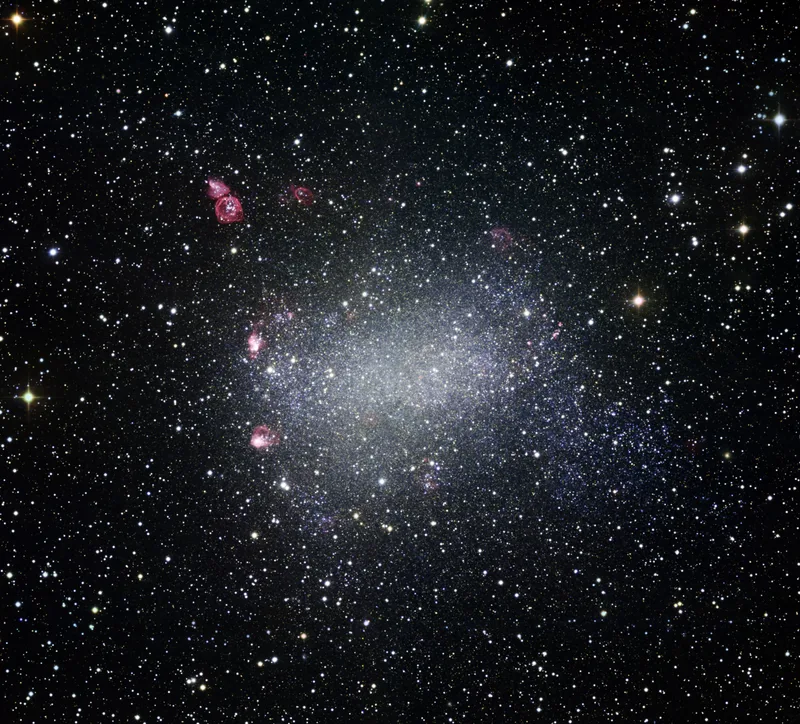
Barnard's Galaxy, NGC 6822 or Caldwell 57, is a dwarf irregular galaxy in Sagittarius and one of the Milky Way's neighbors in the Local Group, about 1.63 million light-years away. E. E. Barnard found it in 1884 with a small refractor. It is a loose bar of stars and star-forming regions rather than a spiral, and its low surface brightness makes it a test of dark skies more than of aperture.
Observing tips
The galaxy lies in northern Sagittarius, a little over a degree north of 55 Sagittarii, and the small, bright planetary nebula NGC 6818 sits about 40 arcminutes to its north as a handy marker. Its magnitude of 9.3 is spread over roughly 14 by 13 arcminutes, so use low power and a wide field. In 10x50 binoculars under dark skies it is a barely seen glow; a 100 mm scope shows a faint bar running roughly north to south. A 200 mm telescope picks out a couple of brighter knots, the largest star-forming regions. From 52°N it reaches only 23°, so wait for a transparent July night.
Because it is faint, use a larger aperture where possible, avoid bright Moon conditions, and use averted vision.
What to expect
NGC 6822 is a gas-rich dwarf galaxy with a stellar bar inside a much larger, faint disk of neutral hydrogen. Edwin Hubble studied its Cepheid variables in the 1920s, and that work helped show that such objects lie far beyond our own galaxy.
A focal length of 600 to 1000 mm frames the 14 arcminute bar with room around it. Long integrations plus H-alpha subframes reveal its pink star-forming regions against the grainy stellar body.