Observer's guide
About Skull Nebula
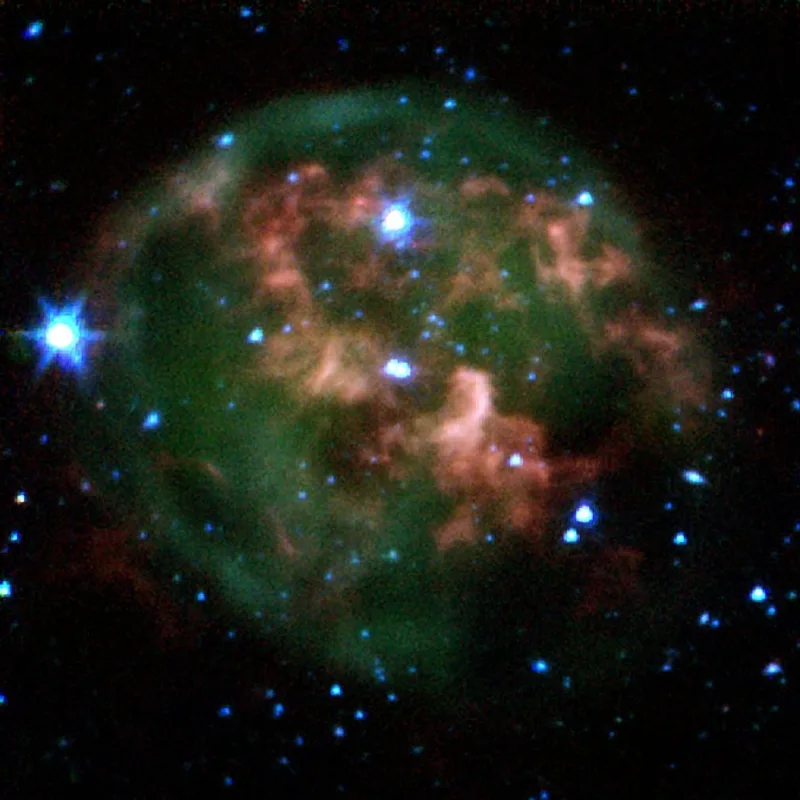
Known as the Skull Nebula, NGC 246 (Caldwell 56) is a planetary nebula in Cetus, about 1,600 light-years away. Its ring is patchy and broken, and with a little imagination the darker holes look like eye sockets. Unusually for a planetary, its central star is easy to see in modest telescopes, which makes it a good object for seeing how these shells surround the dying star that made them.
Observing tips
From Deneb Kaitos (Beta Ceti), move about 6° north to the Phi Ceti stars; the nebula sits a little over a degree south of Phi1 and Phi2. Binoculars rarely show it, since its light is spread over 3.7 arcminutes. A 100 mm scope at 50x to 70x reveals a faint round glow with the central star in the middle, and an OIII or UHC filter helps a lot. In a 200 mm instrument the disk breaks into brighter arcs and darker patches. It transits at about 26° from 52°N, so Europe and the northern US can see it well enough; September and October evenings are best.
A small telescope under reasonably dark skies is a good starting point; use the live altitude chart to choose its highest point.
What to expect
The shell is gas thrown off by a star at the end of its red giant phase, now lit by the hot core left behind. That central star belongs to the rare PG1159 class, extremely hot stars that have lost their hydrogen envelopes and are on their way to becoming white dwarfs.
At 3.7 arcminutes it fills a frame nicely at 1000 to 1500 mm focal length. OIII and H-alpha data bring out the mottled ring and the contrast between its bright and dark patches.