Observer's guide
About Saturn Nebula
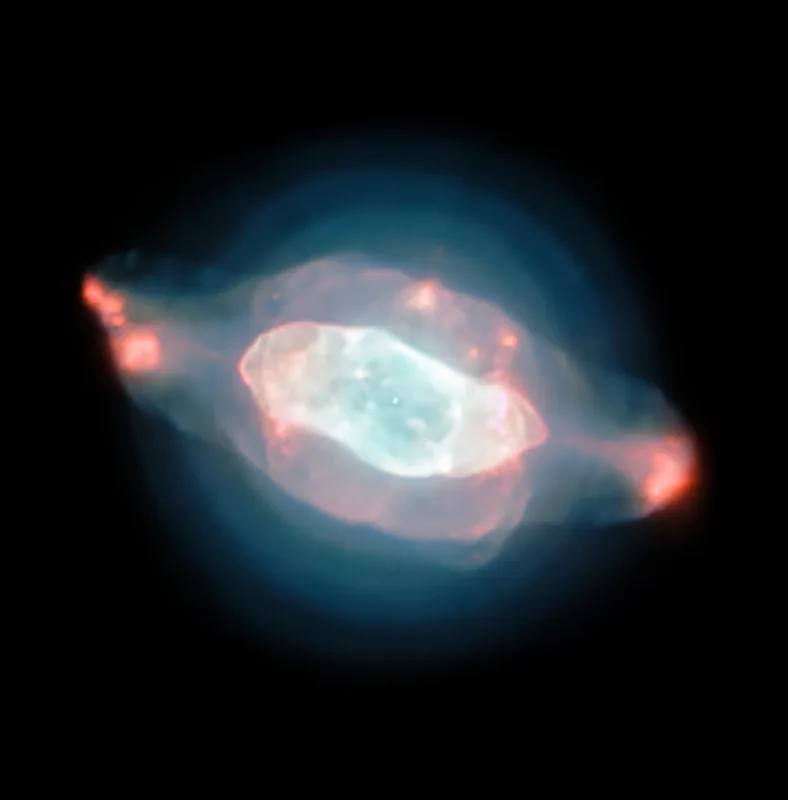
The Saturn Nebula, NGC 7009 or Caldwell 55, is a bright planetary nebula in Aquarius. Its name comes from the faint extensions, or ansae, on either side of its oval disk, which make it look like Saturn seen nearly edge-on. At magnitude 8 and about 0.7 by 0.5 arcminutes, it is small but bright and shows strong color.
Observing tips
Find Nu Aquarii, a 4.5-magnitude star about 8 degrees southwest of Sadalsuud (Beta Aquarii), and move about 1.3 degrees due west. Binoculars show it only as a star. In a 70–100 mm scope at 100x, it is a small, blue-green oval disk. With 200 mm or more at 200–300x on a steady night, the ansae appear as faint extensions on either side. From 52°N it transits only about 27 degrees high, so wait for good seeing and observe it near the meridian.
A small telescope under reasonably dark skies is a good starting point; use the live altitude chart to choose its highest point.
What to expect
NGC 7009 is a shell of gas expelled by a dying star, now ionized by its hot central star. The ansae are knots of gas moving away from the star at high speed, and the overall shape suggests jets or outflows during its formation.
Use 2,000 mm or more and short exposures to keep the bright disk from saturating. OIII and hydrogen-alpha data show the inner shell and the faint ansae.