Observer's guide
About NGC 2244
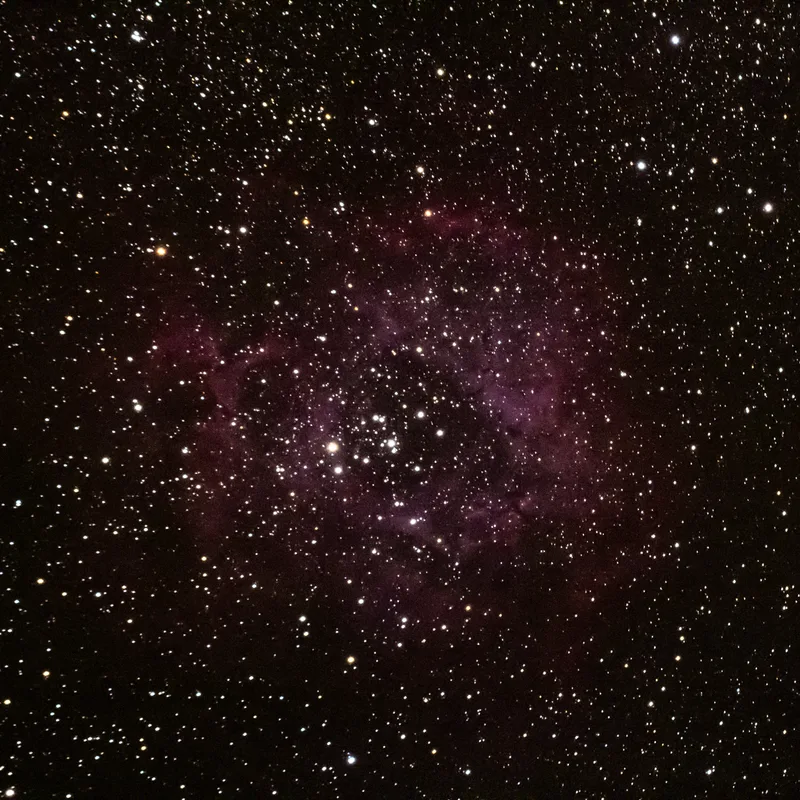
NGC 2244, Caldwell 50, is the young open cluster at the center of the Rosette Nebula in Monoceros, about 4,900 light-years away. Its brightest stars form a neat rectangle that is easy to spot even from suburban skies. At magnitude 4.8 it is plain in binoculars, and its hot young stars supply the energy that makes the surrounding nebula glow.
Observing tips
Find Epsilon Monocerotis and move about 2 degrees east. Binoculars show a compact group of bright stars, including the rectangle, against a faint glow. A 70–100 mm scope at 30–50x shows a few dozen stars, with the surrounding nebula visible as a faint ring under dark skies. With 200 mm or more, the cluster resolves into many more stars, and adding a UHC filter brings out the Rosette around it. Keep magnification low to see the cluster in its setting.
Its brightness makes it a practical binocular or small-telescope candidate when it is well above the horizon.
What to expect
NGC 2244 is only a few million years old and contains several hot, massive O-type stars. Their ultraviolet radiation ionizes the surrounding gas, creating the Rosette Nebula, and their winds have carved out its central cavity.
Frame the cluster with the full Rosette at 300–500 mm. Short RGB exposures capture the star colors, and hydrogen-alpha adds the nebula around them.