Observer's guide
About Iris Nebula
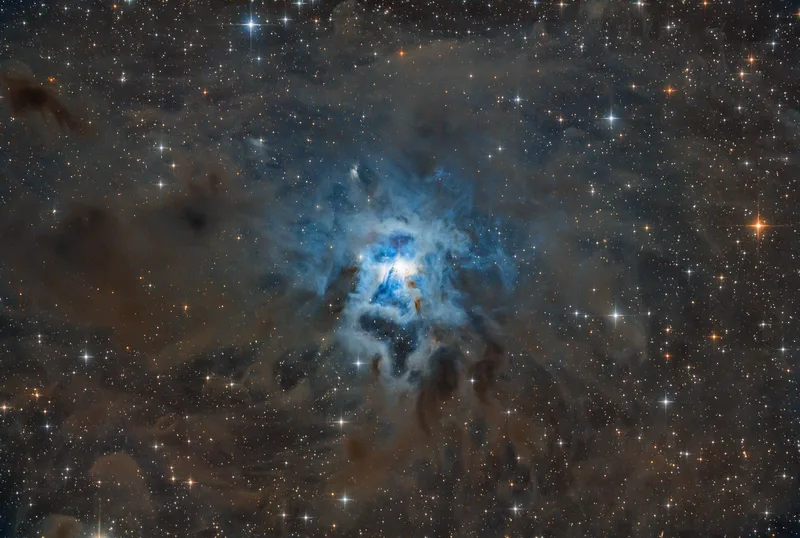
The Iris Nebula, NGC 7023 or Caldwell 4, is a reflection nebula in Cepheus about 1,400 light-years away. Dust surrounding a young 7th-magnitude star scatters its light, giving the nebula the blue color seen in photographs. Dark dust clouds spread out around it for some distance, so the bright core is only the most visible part of a much larger dusty region.
Observing tips
From Beta Cephei (Alfirk), move about 3.5 degrees southwest to the illuminating star. In binoculars you see the star itself and perhaps a faint haze around it on a good night. A 70–100 mm telescope at 50–80x shows a soft glow surrounding the star, best seen with averted vision. With 200 mm or more, the glow becomes a larger, uneven patch, set in a field noticeably poor in background stars because of the surrounding dust. Nebula filters do not help here, since reflected starlight is broadband; a dark, transparent sky does.
A small telescope under reasonably dark skies is a good starting point; use the live altitude chart to choose its highest point.
What to expect
NGC 7023 is a cloud of interstellar dust lit by the hot young star HD 200775, which is not hot enough to make the gas glow strongly. The light you see is mainly starlight scattered by dust grains, a process that favors blue wavelengths.
A focal length of 600–1,000 mm frames the bright core well, while 300–400 mm takes in the surrounding dark nebulae. Long total exposure from a dark site is needed to bring out the brown dust.