Observer's guide
About Rosette Nebula
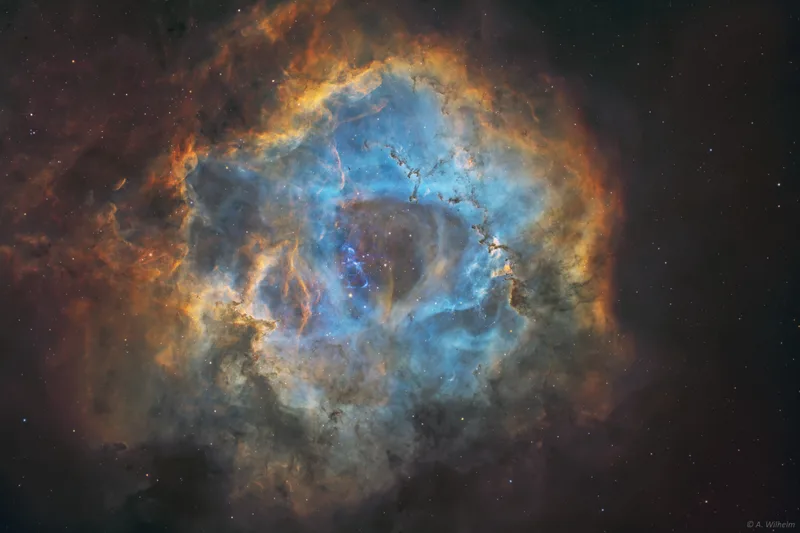
The Rosette Nebula, Caldwell 49, is a large emission nebula in Monoceros about 4,900 light-years away. Its brightest section carries the number NGC 2237, with other parts cataloged as NGC 2238, 2239 and 2246. At its center, the young cluster NGC 2244 (Caldwell 50) has cleared a hole in the gas, giving the nebula its flower shape. It spans more than twice the width of the full Moon.
Observing tips
Find Epsilon Monocerotis, a 4th-magnitude star roughly a third of the way from Betelgeuse toward Procyon, a little south of the line, and move about 2 degrees east. Binoculars show the cluster and, under dark skies with a UHC or OIII filter, a faint ring of nebulosity. A 70–100 mm scope at its lowest power with a filter shows the ring and the dark central hole. With 200 mm or more and a wide eyepiece, you can trace the brighter patches and dark lanes. Use the lowest magnification available.
Because it is faint, use a larger aperture where possible, avoid bright Moon conditions, and use averted vision.
What to expect
The Rosette is a cloud of hydrogen gas ionized by the hot young stars of NGC 2244. Their radiation and winds have hollowed out the center, and dark globules in the gas mark dense pockets where new stars may still be forming.
Use 300–500 mm to frame the whole nebula. Hydrogen-alpha alone shows the structure, and narrowband palettes bring out the contrast between the glowing gas and the dark globules.