Observer's guide
About Hubble's Variable Nebula
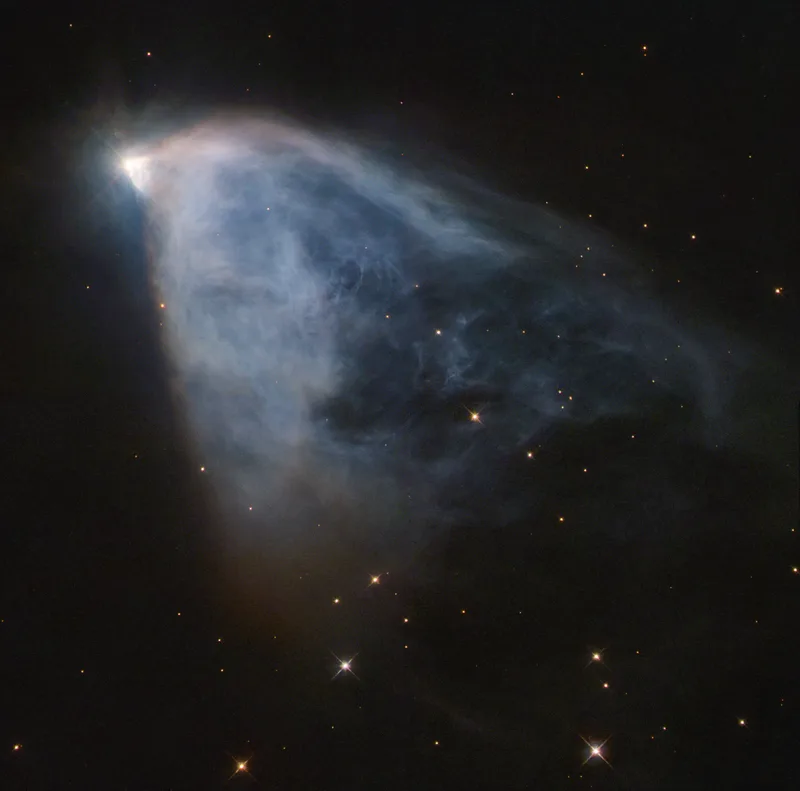
Hubble's Variable Nebula, NGC 2261 or Caldwell 46, is a small reflection nebula in Monoceros about 2,500 light-years away. Its fan shape is lit by the young star R Monocerotis at its tip, and its brightness and structure change over weeks or months as dust near the star casts moving shadows. Edwin Hubble studied these changes, and it was the first object officially photographed with the 200-inch Hale Telescope.
Observing tips
Find the Christmas Tree Cluster (NGC 2264) around the bright star S Monocerotis, and move a little over 1 degree south-southwest. Binoculars may show it as a faint, fuzzy star. A 70–100 mm scope at 60–100x shows a small, comet-shaped glow with a bright point at one end. With 200 mm or more at 150x and above, the fan shape becomes clear. Compare sketches over several months to see how it changes.
Because it is faint, use a larger aperture where possible, avoid bright Moon conditions, and use averted vision.
What to expect
R Monocerotis is a very young star still wrapped in gas and dust. The nebula is dust lit by its light, and clumps of material moving close to the star cast shadows that alter the nebula's appearance.
Use 1,500–2,500 mm to show the fan shape. Short exposures preserve the bright tip, and comparing images taken weeks apart can reveal visible changes.