Observer's guide
About NGC 4236
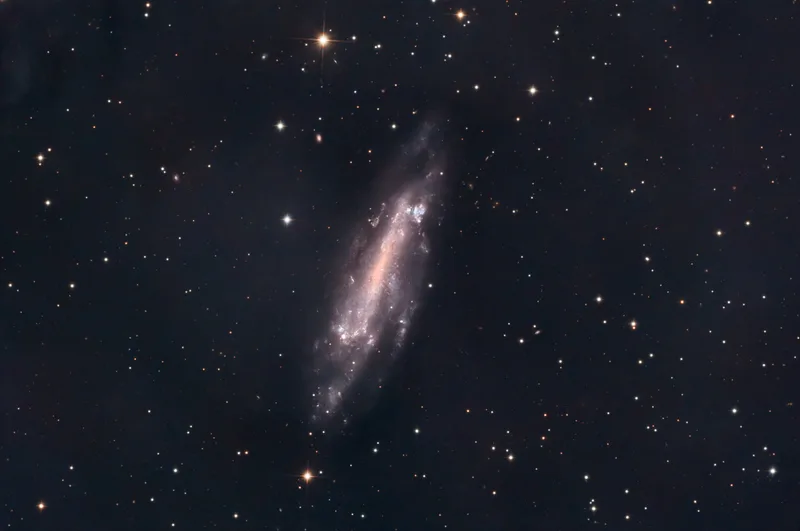
NGC 4236, number 3 in the Caldwell catalog, is a large barred spiral galaxy in Draco, seen at a steep angle so that it appears as a long, faint streak. It measures about 12.5 by 3 arcminutes and lies roughly 7 million light-years away, close by galactic standards. Despite a total magnitude of 10.5, its light is spread thinly, which makes it one of the harder Caldwell galaxies to see.
Observing tips
Locate Kappa Draconis, a 4th-magnitude star in the dragon's tail between the two Dippers, and move about 1.5 degrees west. Binoculars are unlikely to show it. In a 70–100 mm scope you need a properly dark sky, low power and averted vision to catch a pale, elongated haze. A 200 mm or larger telescope at 60–100x shows the length of the galaxy more clearly and, on the best nights, some faint patchiness along it. Light pollution and haze wipe it out quickly, so save it for transparent nights when Draco is high.
Because it is faint, use a larger aperture where possible, avoid bright Moon conditions, and use averted vision.
What to expect
NGC 4236 is a late-type barred spiral with a weak central bulge and loose, poorly defined arms. It is generally counted as a member of the M81 group, and its disk contains scattered regions of star formation.
Its 12.5 arcminute length suits focal lengths around 800–1,200 mm. Collect plenty of total integration from a dark site to lift the faint disk and its pinkish star-forming knots above the sky background.