Observer's guide
About East Veil Nebula
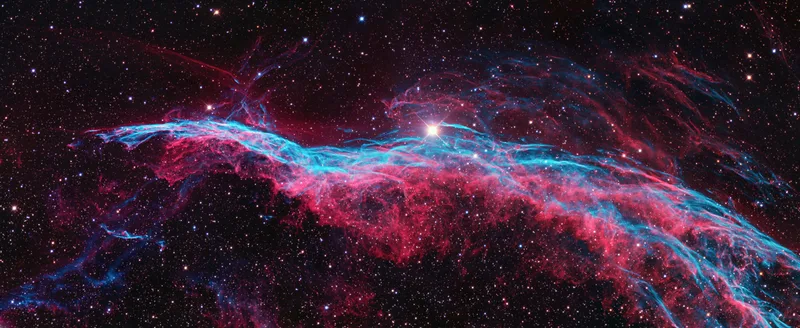
The Eastern Veil Nebula, NGC 6992 or Caldwell 33, is one of the brightest parts of the Cygnus Loop, a large supernova remnant about 2,500 light-years away. It appears as a long, curved arc of filaments on the eastern side of the loop, with NGC 6995 at its southern end. Its partner on the opposite side is the Western Veil, Caldwell 34.
Observing tips
From Epsilon Cygni (Gienah), the star at the end of the cross's eastern arm, move about 3 degrees southeast. Without a filter it is difficult in any telescope, but an OIII filter makes a dramatic difference. Binoculars with OIII filters can show the arc on a dark night, and a 70–100 mm scope with an OIII filter at 20–40x shows a long, faint, curving filament. With a 200 mm telescope at 50–80x, the arc breaks into braided, rope-like strands. Use low power and scan along its length.
A small telescope under reasonably dark skies is a good starting point; use the live altitude chart to choose its highest point.
What to expect
The Cygnus Loop is the expanding debris shell of a star that exploded thousands of years ago. The Veil filaments are where the shock wave strikes the surrounding gas, heating it and causing it to glow.
Use 400–800 mm for the eastern arc alone, or 200–300 mm to include the whole loop. Hydrogen-alpha and OIII together show the red and blue-green filaments well.