Observer's guide
About Flaming Star Nebula
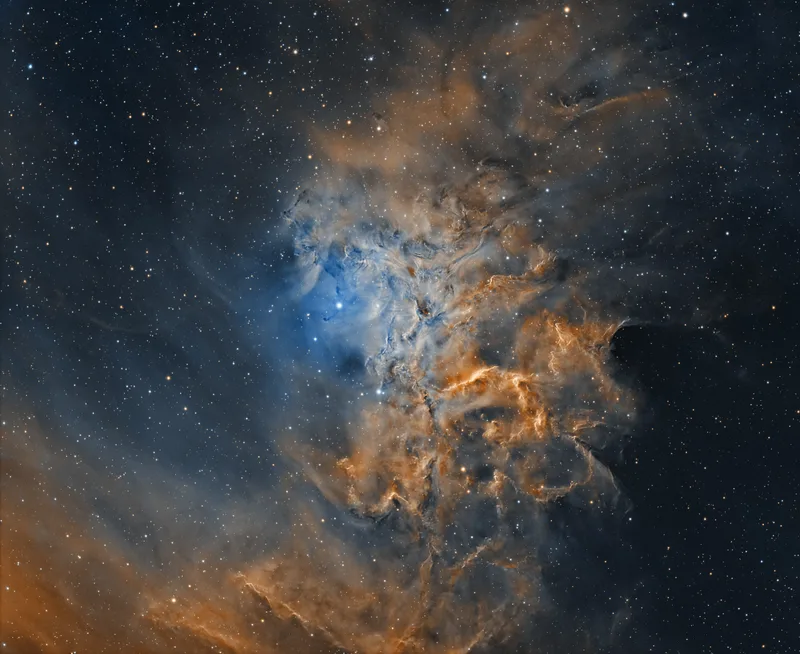
The Flaming Star Nebula, IC 405 or Caldwell 31, is a mix of emission and reflection nebula in Auriga about 1,600 light-years away. It is lit by AE Aurigae, a hot young star moving quickly through space after being ejected from the Orion region. The name comes from the streaky, flame-like filaments seen in photographs.
Observing tips
Find Iota Aurigae (Hassaleh), the southwestern corner of the Auriga pentagon, and move about 4 degrees east-northeast to the 6th-magnitude star AE Aurigae. Binoculars show the star but little nebulosity. A 70–100 mm scope at low power may show a faint haze around the star on a dark night. With 200 mm or more at 40–70x, the glow becomes more apparent, and an H-beta filter can help with the emission part. Keep the star near the edge of the field to reduce glare.
Its brightness makes it a practical binocular or small-telescope candidate when it is well above the horizon.
What to expect
AE Aurigae is a runaway star, thought to have been ejected from the region of the Orion Nebula a few million years ago. It is passing through a cloud of gas and dust, causing the hydrogen to glow red and the dust to reflect blue light.
Use 300–600 mm to frame the nebula with IC 410 nearby. Hydrogen-alpha shows the red filaments, while RGB data captures the blue reflection around the star.