Observer's guide
About NGC 7331
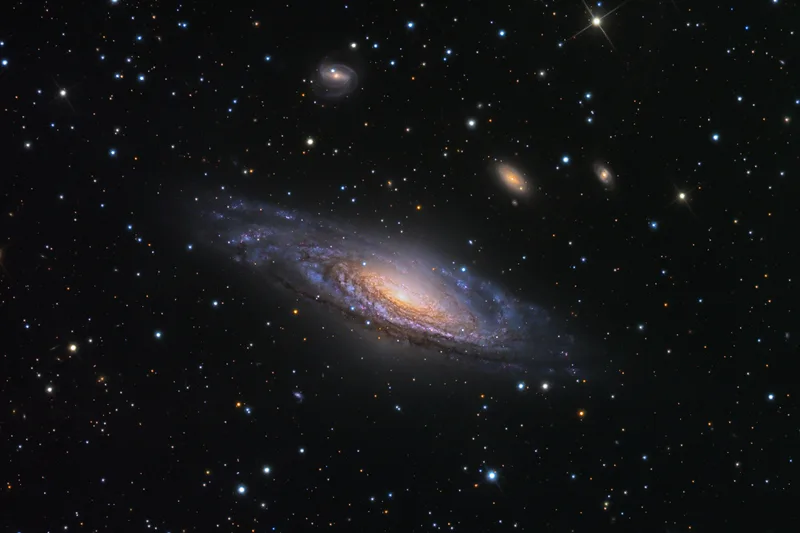
NGC 7331, Caldwell 30, is a large spiral galaxy in Pegasus about 47 million light-years away, often compared with the Milky Way in size and structure. At magnitude 9.5 and about 10.5 by 4.2 arcminutes, it is one of the brightest autumn galaxies not in the Messier catalog. Stephan's Quintet, a famous compact group of galaxies, lies about half a degree to the south-southwest.
Observing tips
From Eta Pegasi (Matar), the star beyond Scheat on the northern leg of Pegasus, move about 4.5 degrees north-northwest. Binoculars may show a faint smudge on a dark night. A 70–100 mm scope at 60–80x shows an elongated glow with a bright core. With 200 mm or more at 120–150x, one side of the disk looks sharper because of a dust lane, and several small companion galaxies appear nearby. Then try for Stephan's Quintet, which needs at least 200 mm and a dark sky.
Because it is faint, use a larger aperture where possible, avoid bright Moon conditions, and use averted vision.
What to expect
NGC 7331 is a spiral galaxy with a bright central bulge and tightly wound arms. It is inclined steeply to our line of sight, so its dust lanes are prominent on one side of the core.
Its 10.5 arcminute size suits 1,000–1,500 mm, and around 800 mm frames it with Stephan's Quintet. Long integration shows the dust lanes and the faint companion galaxies.