Observer's guide
About Bow-Tie Nebula
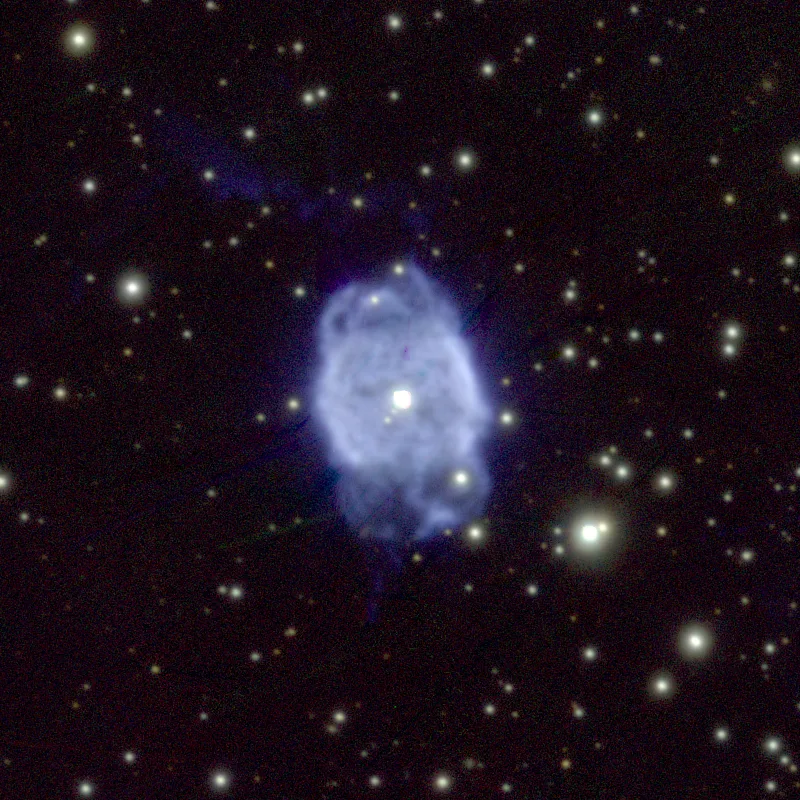
Caldwell 2, cataloged as NGC 40, is a planetary nebula in northern Cepheus often called the Bow-Tie Nebula for the brighter lobes on either side of its central star. It shines at about magnitude 11 and lies roughly 3,500 light-years away. The central star is unusually easy to pick out for a planetary nebula, which helps you confirm you are on target in a sparse field.
Observing tips
Find Caph (Beta Cassiopeiae) at the western end of the W and move about 13 degrees due north into a quiet part of Cepheus. Binoculars will not show it in any useful way. A 70–100 mm scope at 80–100x shows a small fuzzy disk around an obvious central star. In a 200 mm instrument at 150x or more, the oval becomes clearer, with brighter patches on opposite sides that give the bow-tie impression. An OIII or UHC filter adds a little contrast to the shell, though it also dims the central star.
Because it is faint, use a larger aperture where possible, avoid bright Moon conditions, and use averted vision.
What to expect
NGC 40 is a shell of gas thrown off by a dying star at the end of its red giant phase. The central star is a hot Wolf-Rayet type object, classed [WC8], whose strong wind and ultraviolet light shape and ionize the surrounding nebula.
The nebula is roughly an arcminute across, so use 1,500 mm or more and nights of good seeing. Combining hydrogen-alpha and OIII data brings out the brighter lobes and the fainter gas between them.