Observer's guide
About Crescent Nebula
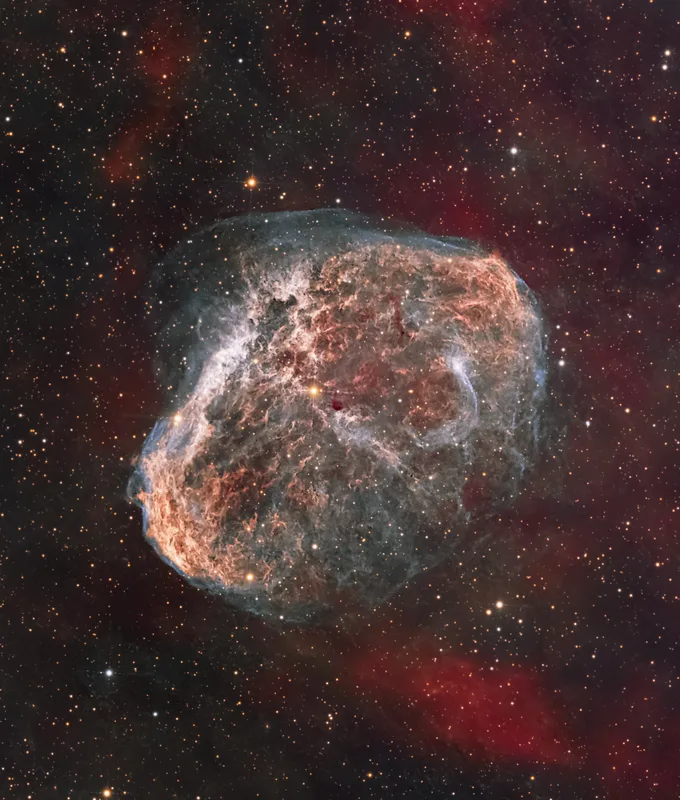
The Crescent Nebula, NGC 6888 or Caldwell 27, is an emission nebula in Cygnus about 4,700 light-years away. It is a shell of gas blown out by the Wolf-Rayet star WR 136, one of the hottest and most luminous types of star. Visually it appears as a faint arc, while deep photographs reveal a full shell with fine filaments and a faint blue-green outer skin.
Observing tips
From Sadr (Gamma Cygni), at the center of the Northern Cross, move about 2.5 degrees southwest. Binoculars rarely show it. A 70–100 mm scope with an OIII filter can show a faint arc on dark nights. With 200 mm or more at 50–80x and an OIII or UHC filter, the brighter side of the crescent becomes clear and the outline of the full oval may be traced. Without a filter it is much harder, even in a large telescope.
A small telescope under reasonably dark skies is a good starting point; use the live altitude chart to choose its highest point.
What to expect
WR 136 is a massive star near the end of its life. It previously shed material as a red supergiant, and its current fast wind is sweeping that material into a shell, which the star's ultraviolet light makes glow.
A focal length of 600–1,000 mm frames the shell nicely. Combine hydrogen-alpha with OIII; the OIII signal is faint but shows the blue-green envelope outside the red filaments.