Observer's guide
About Perseus A
Perseus A, the galaxy NGC 1275 or Caldwell 24, sits at the heart of the Perseus galaxy cluster, about 230 million light-years away. It is one of the strongest radio sources in the sky, powered by a supermassive black hole at its center. At magnitude 11.9 and about 2.6 by 1.8 arcminutes, it is a modest sight in the eyepiece, but the many fainter galaxies around it add interest.
Observing tips
Start at Algol (Beta Persei) and move about 2 degrees east, a little north. Binoculars will not show it, and a 70–100 mm scope shows at most a faint spot with averted vision. A 200 mm or larger telescope at 100–150x shows a small, round glow with a brighter core, and with care several other cluster galaxies appear nearby as faint smudges. Use a detailed chart to identify them. A dark sky and good transparency are essential for galaxies this distant.
Because it is faint, use a larger aperture where possible, avoid bright Moon conditions, and use averted vision.
What to expect
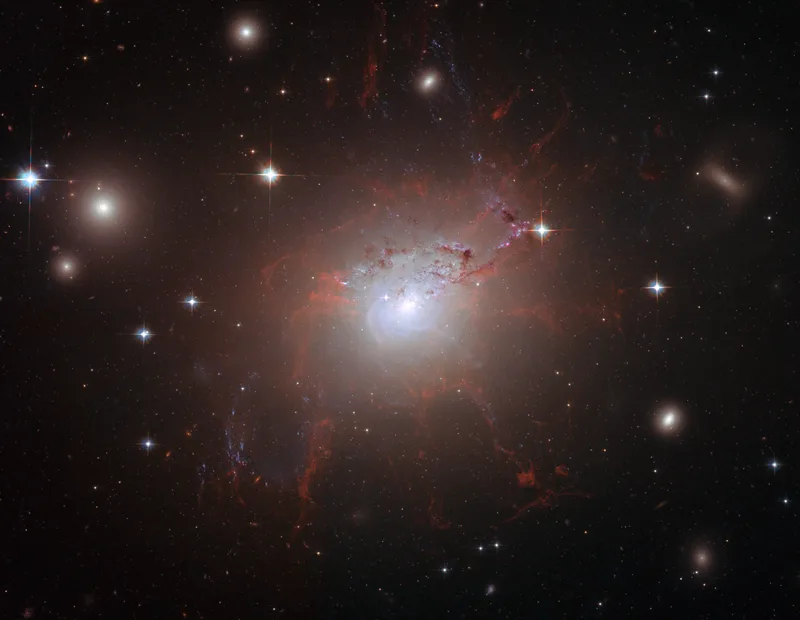
NGC 1275 is a giant elliptical galaxy at the center of the Perseus Cluster. Its active nucleus drives jets that inflate bubbles in the cluster's hot, X-ray emitting gas, and long filaments of cooler gas surround the galaxy.
Use 1,000–1,500 mm to frame NGC 1275 with the surrounding cluster galaxies. Very long hydrogen-alpha exposures can capture the faint gas filaments around it.