Observer's guide
About NGC 891
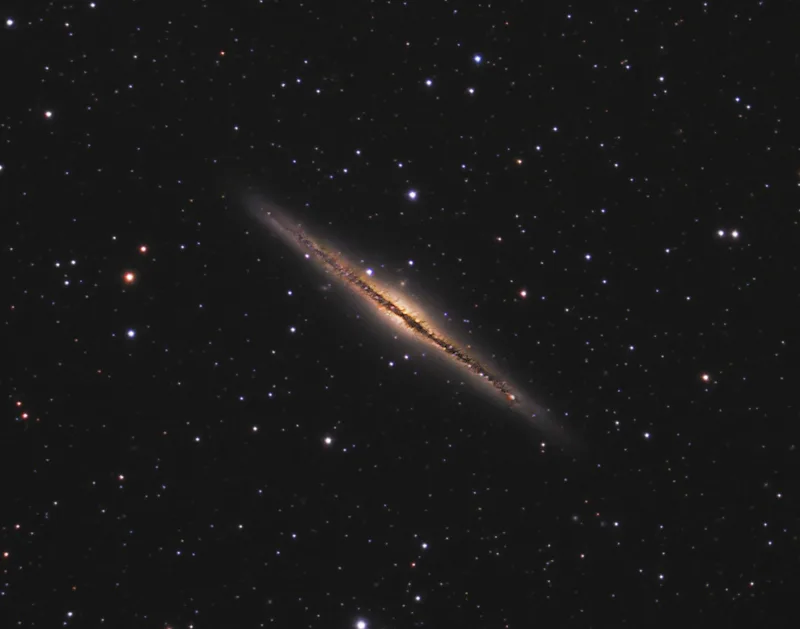
NGC 891, Caldwell 23, is a spiral galaxy in Andromeda seen almost exactly edge-on, with a dark dust lane running along its length. It is often described as a view of what our own Milky Way would look like from the side. The galaxy lies about 31 million light-years away and measures roughly 12.3 by 2.5 arcminutes, but at magnitude 10.8 its light is faint and spread out.
Observing tips
Start at Almach (Gamma Andromedae), the bright double star at the eastern end of Andromeda, and move about 3.5 degrees due east. Binoculars do not show it. A 70–100 mm scope under a dark sky shows a faint, thin streak, best seen with averted vision. In a 200 mm or larger telescope at 100–150x, the dust lane splits the glow along most of its length, which is the view to aim for. It needs a dark, transparent sky and is best when high on autumn evenings.
Because it is faint, use a larger aperture where possible, avoid bright Moon conditions, and use averted vision.
What to expect
NGC 891 is a spiral galaxy similar in size and type to the Milky Way, viewed from within its plane. Detailed images show filaments of dust and gas rising well above the disk, driven out by star formation and supernovae.
Its 12 arcminute length suits 1,000–1,500 mm. Long integration and careful processing bring out the dust filaments above the disk and the many background galaxies in the field.