Observer's guide
About Copeland's Blue Snowball
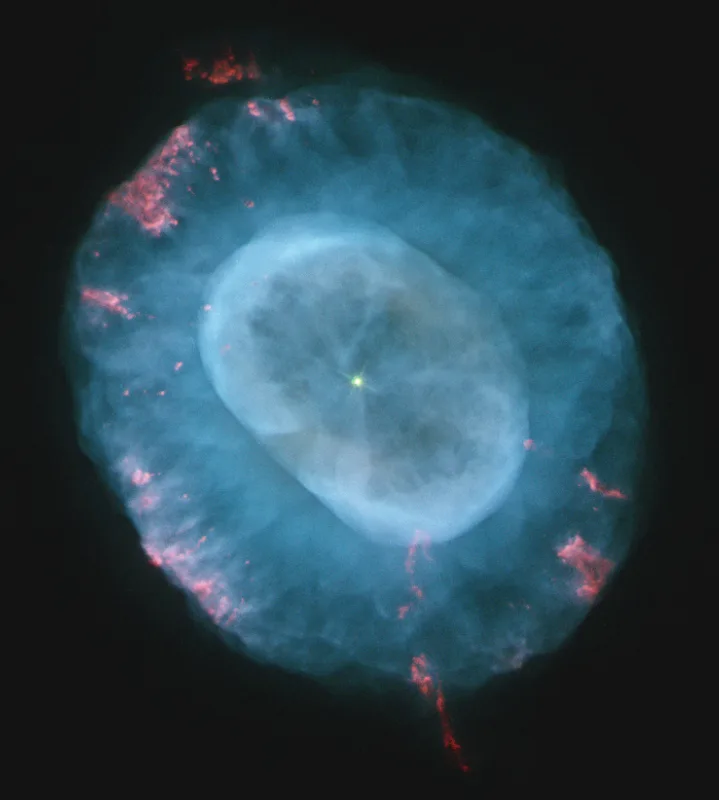
Copeland's Blue Snowball, NGC 7662 or Caldwell 22, is a bright planetary nebula in Andromeda about 3,200 light-years away. It shines at magnitude 8.3 but is only about 0.4 arcminutes across, so at low power it looks like a slightly swollen star. Its strong blue-green color, obvious in small telescopes, gives it its popular name.
Observing tips
Find Iota Andromedae, a 4th-magnitude star northwest of the main chain of Andromeda, and move a little over 2 degrees west-southwest. Binoculars show it only as a star. In a 70–100 mm scope at 100x, a small blue disk is clear, and higher power makes it obvious. A 200 mm telescope at 200–300x shows a brighter rim around a slightly darker center, with a fainter outer shell beyond. An OIII filter blinked in and out picks it out quickly at low power.
A small telescope under reasonably dark skies is a good starting point; use the live altitude chart to choose its highest point.
What to expect
NGC 7662 consists of gas ejected by a dying star, now ionized by its very hot central star. Deep images show a bright inner shell inside a fainter outer one, along with small knots near its edges.
With a size of about 0.4 arcminutes, it needs 2,000 mm or more and good seeing. Short exposures preserve the inner structure, and an OIII filter captures its strong blue-green emission.