Observer's guide
About North America Nebula
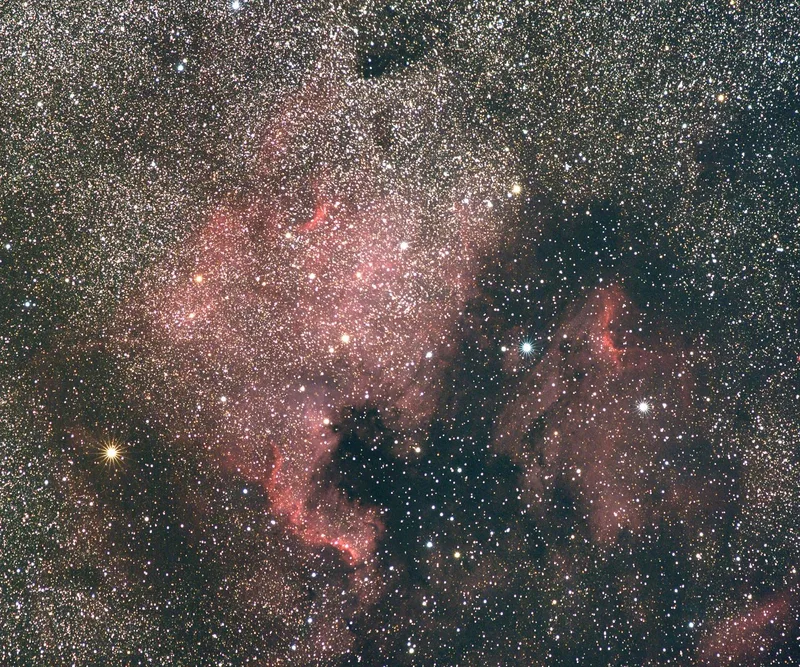
The North America Nebula, NGC 7000 or Caldwell 20, is a large emission nebula in Cygnus that really does resemble the outline of the continent, complete with a dark Gulf of Mexico. It lies about 2,600 light-years away and spans several full-Moon widths, close to the bright star Deneb. Under dark skies it is visible to the naked eye as a brighter patch in the Milky Way.
Observing tips
Look about 3 degrees east of Deneb. Because the nebula is so large, binoculars or a wide-field telescope give the best view; high power shows only an even glow. With a UHC or OIII filter held in front of binoculars or used in a short-focus 70–100 mm scope, the continent shape and the dark gulf become clear. A 200 mm telescope at its lowest power lets you trace the bright Cygnus Wall along the Mexico and Central America coastline. The Pelican Nebula (IC 5070) lies just to the west across a dark lane.
Its brightness makes it a practical binocular or small-telescope candidate when it is well above the horizon.
What to expect
NGC 7000 is a cloud of hydrogen gas ionized by hot young stars, part of the same complex as the Pelican Nebula. The dark Gulf of Mexico is a foreground dust cloud that blocks light from the glowing gas behind it.
Its size calls for 200–400 mm to frame the whole continent and the Pelican. Hydrogen-alpha alone shows the structure well, and narrowband data brings out the sharp edge of the Cygnus Wall.