Observer's guide
About Polarissima Cluster
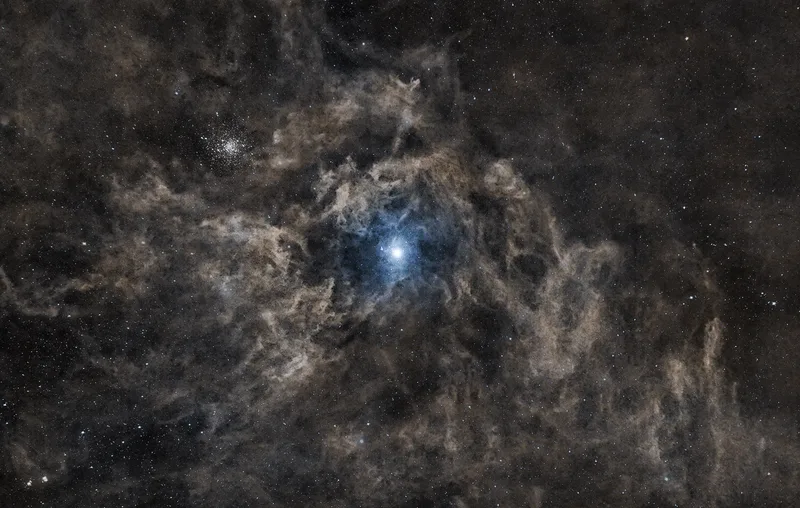
Sitting about 4 degrees from Polaris, NGC 188 (Caldwell 1) is an open cluster in Cepheus that never sets for northern observers. Its nickname, the Polarissima Cluster, comes from that position close to the celestial pole. It is one of the oldest open clusters known in our galaxy, which is unusual, since most open clusters disperse long before reaching such an age. At magnitude 8.1 and about 32 arcminutes across, it is a broad, faint sprinkle of stars rather than a bright knot.
Observing tips
Start at Polaris and move about 4 degrees toward Cassiopeia. The field has few bright guide stars, so a finder chart or setting circles help. Binoculars show at most a faint, even haze under dark skies. A 70–100 mm telescope at 30–50x turns it into a grainy glow with a scattering of faint stars, while a 200 mm scope resolves many dozens of dim, fairly uniform stars across the field. Because it stays high all year from mid-northern latitudes, you can observe it on any clear night, though autumn evenings put it highest.
A small telescope under reasonably dark skies is a good starting point; use the live altitude chart to choose its highest point.
What to expect
With an age usually estimated at several billion years, NGC 188 has survived the tidal encounters that break up most open clusters. Its stars are old and share the same age, which makes the cluster a standard reference for studying how Sun-like stars evolve. It lies about 4,800 light-years away.
At roughly half a degree across, the cluster fits comfortably at 400–800 mm focal length. Aim for many short, well-focused subs to keep the faint stars tight, and leave some surrounding sky in the frame to show how it stands out.