Observer's guide
About Cocoon Nebula
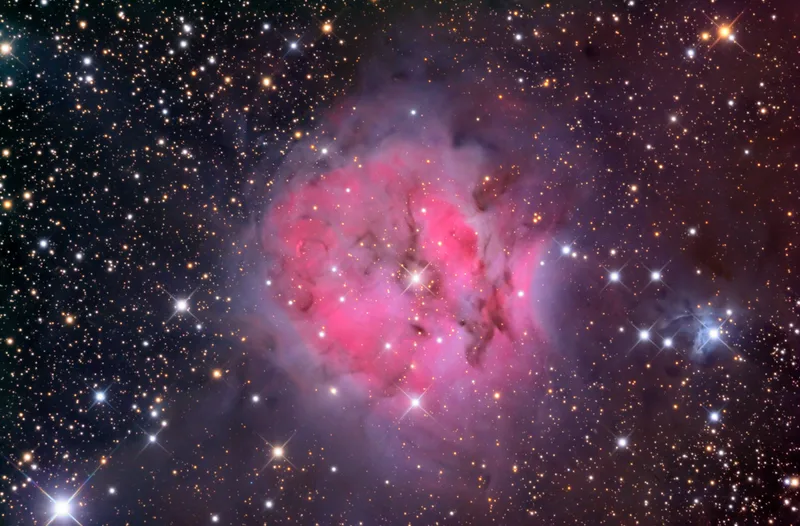
The Cocoon Nebula, IC 5146 or Caldwell 19, is a small nebula in Cygnus about 3,300 light-years away. It combines red emission, blue reflection and a young star cluster, all at the end of a long, dark lane of dust known as Barnard 168. The bright part is about 8 arcminutes across, and the contrast between the glowing knot and the dark trail leading to it makes the area memorable.
Observing tips
Start at the open cluster M39 and move about 3.5 degrees east-southeast, following the dark lane Barnard 168 if your sky is dark enough to show it. In binoculars the dark nebula can appear as a starless streak, but the Cocoon itself is very faint. A 70–100 mm scope shows at best a dim glow around its central star. With 200 mm or more at 60–100x, a soft round haze becomes clearer, and a UHC filter helps the emission part a little. A dark, transparent sky is essential.
Because it is faint, use a larger aperture where possible, avoid bright Moon conditions, and use averted vision.
What to expect
IC 5146 is a region where a young cluster has formed inside a cloud of gas and dust. Hot stars ionize hydrogen to produce the red glow, dust scatters starlight blue, and the dark lane Barnard 168 is part of the same cloud.
Use 400–600 mm to include the dark lane, or around 1,000 mm for detail in the 8 arcminute core. Combine RGB with hydrogen-alpha, and expose long enough to bring out the dark dust trail.