Observer's guide
About NGC 147
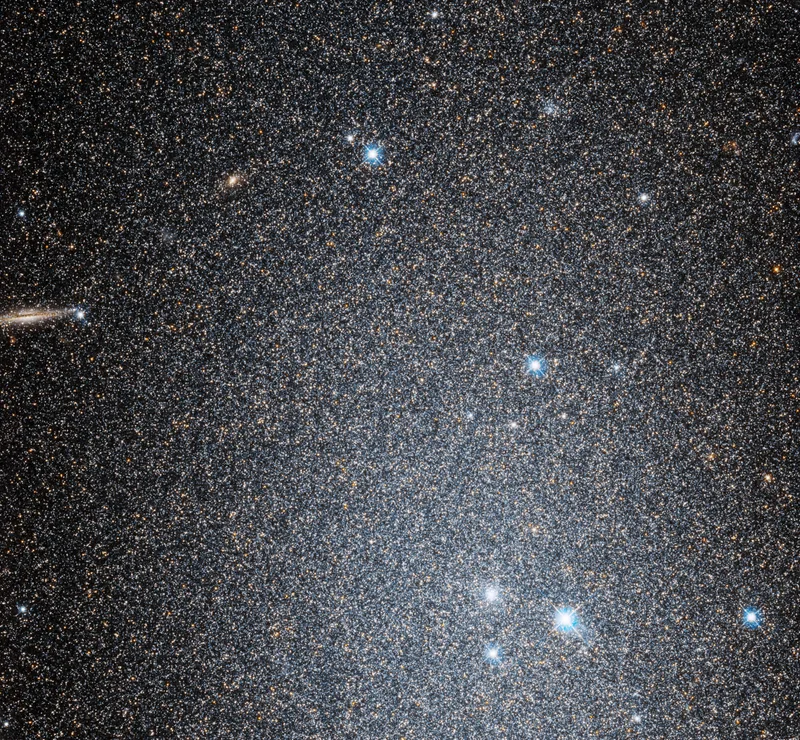
NGC 147, Caldwell 17, is a dwarf galaxy in Cassiopeia and one of the satellites of the Andromeda Galaxy, about 2.3 million light-years away. It forms a pair with NGC 185, roughly a degree to the east. Although its total magnitude is 9.5, the light is spread over about 13 by 7 arcminutes, so its surface brightness is very low and it is the harder of the two to see.
Observing tips
Find Omicron Cassiopeiae, a 4.5-magnitude star about 8 degrees south of Schedar, then move a degree west to NGC 185 and another degree west to NGC 147. Binoculars will not show it. A 70–100 mm scope needs a very dark sky and averted vision to show a faint, slightly elongated glow. In a 200 mm or larger telescope at 60–90x, it appears as a dim, even oval with little central brightening. Pick it up after NGC 185, which helps you judge what to expect.
Because it is faint, use a larger aperture where possible, avoid bright Moon conditions, and use averted vision.
What to expect
NGC 147 is a dwarf spheroidal galaxy made mostly of old stars, with very little gas or ongoing star formation. It is one of several small galaxies bound to the Andromeda Galaxy and orbiting it.
At about 13 arcminutes, it frames well at 800–1,200 mm, or at 400–500 mm together with NGC 185. Deep luminance from a dark site shows its smooth, faint outer halo.