Observer's guide
About NGC 7243
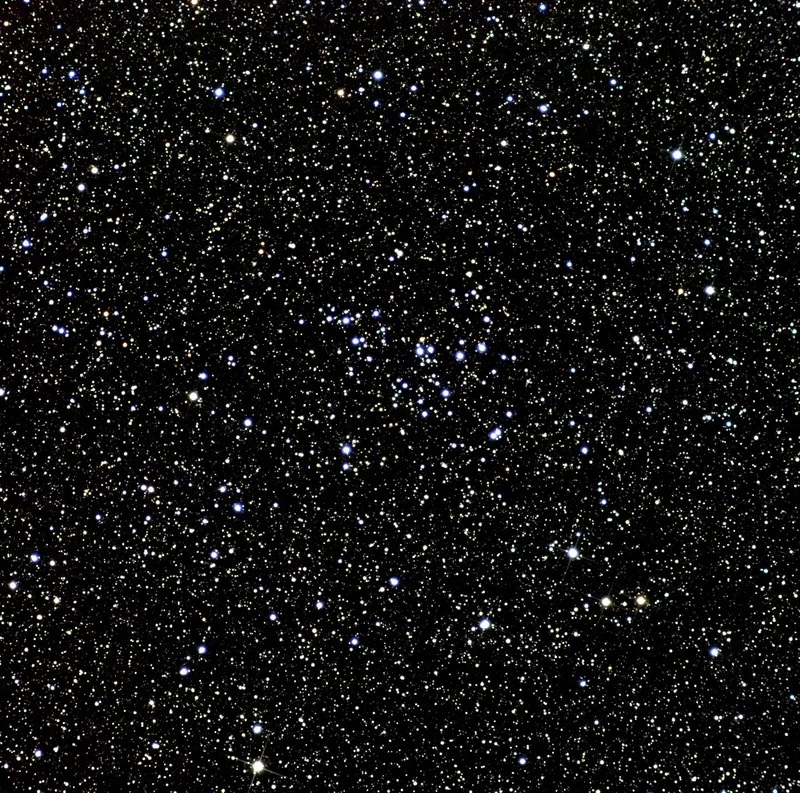
NGC 7243, Caldwell 16, is a loose open cluster in the small constellation Lacerta, between Cygnus and Cassiopeia. At magnitude 6.4 and about 30 arcminutes across, it is bright and large enough for binoculars. It lies roughly 2,500 light-years away. Its stars are scattered rather than concentrated, so it can be hard to tell where the cluster ends and the Milky Way background begins.
Observing tips
Find Alpha Lacertae, the brightest star in the faint zigzag of Lacerta, and move about 2.5 degrees west. Binoculars show a scattered group of stars with some haze. A 70–100 mm scope at 30–50x gives the best view, showing a few dozen stars in an irregular spread. With 200 mm or more, the extra stars add depth, but keep the power low so the field holds the whole cluster. The rich Milky Way here makes it a good area to sweep slowly.
A small telescope under reasonably dark skies is a good starting point; use the live altitude chart to choose its highest point.
What to expect
NGC 7243 is an open cluster whose stars formed together and are gradually drifting apart. Its loose structure is typical of clusters that are only weakly bound by their own gravity and are steadily losing members to the galactic field.
Its half-degree size frames comfortably at 400–700 mm. Expose for star color and include enough of the surrounding star field to show the cluster's outline.