Observer's guide
About Blinking Planetary Nebula
The Blinking Planetary, NGC 6826 or Caldwell 15, is a planetary nebula in Cygnus about 2,200 light-years away. Its name comes from an effect at the eyepiece: look straight at the bright central star and the nebula fades, look slightly away and it reappears. At magnitude 8.8 and about 0.7 arcminutes across, it is small but fairly bright.
Observing tips
Begin at Delta Cygni, at the end of the cross's western arm, and move about 5 degrees north to the wide pair 16 Cygni; the nebula lies about half a degree east. Binoculars show it only as a starlike point. A 70–100 mm scope at 80–120x shows a small round disk around the central star, and the blinking effect is easy to try. A 200 mm telescope at 150–250x shows a blue-green disk with a brighter inner zone. An OIII filter brightens the shell and dims the star, which makes the blinking less obvious.
A small telescope under reasonably dark skies is a good starting point; use the live altitude chart to choose its highest point.
What to expect
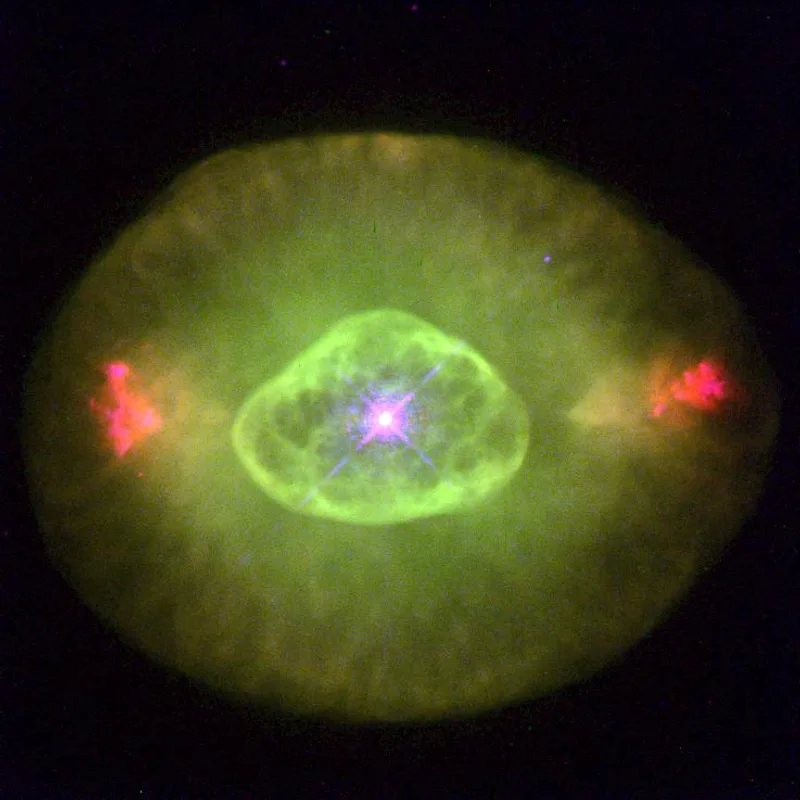
NGC 6826 is a shell of gas expelled by an aging star and now ionized by the hot remnant at its center. Deep images show a bright inner shell surrounded by a fainter halo, with small reddish knots, known as FLIERs, at either end.
Use 2,000 mm or more and short subs to keep the central star from overwhelming the shell. A separate set of long exposures brings out the faint outer halo.