Observer's guide
About Double Cluster
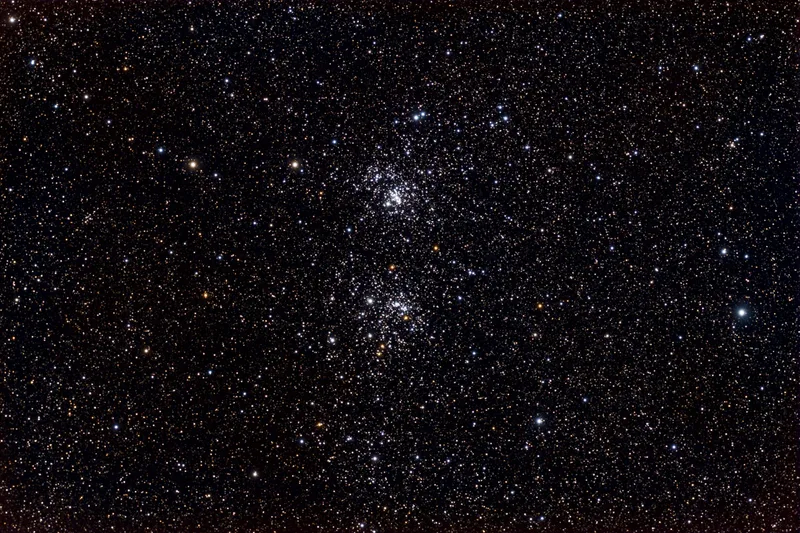
The Double Cluster, Caldwell 14, is a pair of rich open clusters in Perseus known as h and chi Persei, or NGC 869 and NGC 884. They sit side by side about 7,300 light-years away and together reach magnitude 4.3, bright enough to see without optical aid from a dark site. In binoculars or a wide-field telescope, they are among the finest sights in the northern sky.
Observing tips
Look between the W of Cassiopeia and Mirfak (Alpha Persei); from a dark site the naked eye shows a hazy patch. Binoculars show two bright, grainy clusters in one field, and this is one of the best binocular objects of the year. A 70–100 mm scope at 25–40x fits both clusters and resolves many dozens of stars. With 200 mm or more, use a low-power wide eyepiece or look at each cluster in turn; NGC 884 contains several reddish supergiants that stand out against the blue-white stars.
Its brightness makes it a practical binocular or small-telescope candidate when it is well above the horizon.
What to expect
NGC 869 and NGC 884 are young clusters, around 13 million years old, belonging to the Perseus OB1 association. They contain hot, massive blue stars and several red supergiants, stars massive enough to have already left the main sequence.
Together the two clusters span about a degree, so 300–500 mm frames them well. Short subs preserve star color, and a wider field shows the surrounding star clouds of Perseus.