Observer's guide
About Owl Cluster
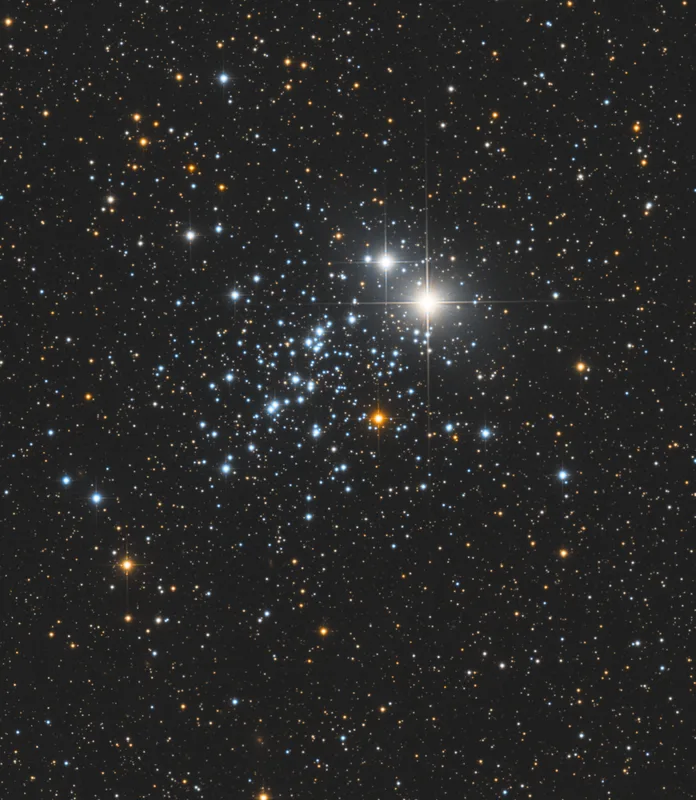
NGC 457, Caldwell 13, is a bright open cluster in Cassiopeia known as the Owl Cluster, and also as the ET Cluster. Two bright stars mark the eyes, and chains of fainter stars form the outstretched wings or arms. At magnitude 6.4 and about 15 arcminutes across, it is easy in small telescopes and lies roughly 7,900 light-years away.
Observing tips
From Delta Cassiopeiae (Ruchbah), move about 2 degrees south-southwest. The brighter of the two eye stars, 5th-magnitude Phi Cassiopeiae, is plain in binoculars along with a small haze of fainter stars. A 70–100 mm scope at 40–60x shows the full figure, with the two eyes, a body of stars and long wings. With 200 mm or more, many more faint stars fill in, and a reddish star near the middle stands out. Moderate power gives the best balance between resolving stars and keeping the shape.
A small telescope under reasonably dark skies is a good starting point; use the live altitude chart to choose its highest point.
What to expect
NGC 457 is a young open cluster of hot stars that formed together from the same cloud. Phi Cassiopeiae may be either a foreground star or a genuine luminous member of the cluster; its distance is still debated.
The cluster's 15 arcminutes suit 600–1,000 mm. Keep exposures short so the bright eye stars do not swamp the field, and aim for good color in the reddish and blue members.