Observer's guide
About Fireworks Galaxy
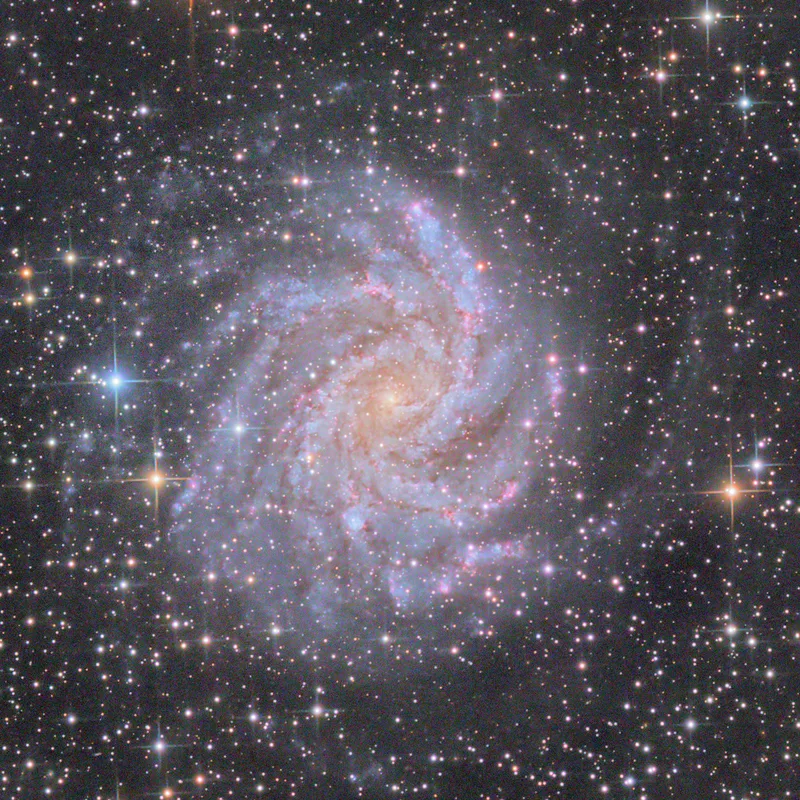
Caldwell 12, the Fireworks Galaxy NGC 6946, is a face-on spiral in Cepheus, right on the border with Cygnus. Its nickname reflects its record of supernovae: around ten have been observed in it since 1917, more than in almost any other galaxy. It lies about 18 million light-years away, behind a thick veil of Milky Way dust that dims it considerably.
Observing tips
Start at Eta Cephei and move about 2 degrees southwest; the open cluster NGC 6939 lies on the way, well under a degree northwest of the galaxy. Binoculars rarely show it. A 70–100 mm scope under a dark sky shows a large, faint round glow that needs averted vision. With 200 mm or more at 80–120x, you see a slightly brighter center and, on good nights, a patchy texture hinting at the arms. Since its surface brightness is low, transparency matters more than magnification.
Because it is faint, use a larger aperture where possible, avoid bright Moon conditions, and use averted vision.
What to expect
NGC 6946 is a spiral galaxy with vigorous star formation throughout its arms, producing many massive stars that end as supernovae. Seen almost face-on, it lies close to the Milky Way's plane on the sky, so interstellar dust reduces its apparent brightness.
At about 11.5 arcminutes, it suits 1,000–1,500 mm, or 500–700 mm to include NGC 6939. Long integration plus hydrogen-alpha brings out the star-forming knots along the arms.