Observer's guide
About Bubble Nebula
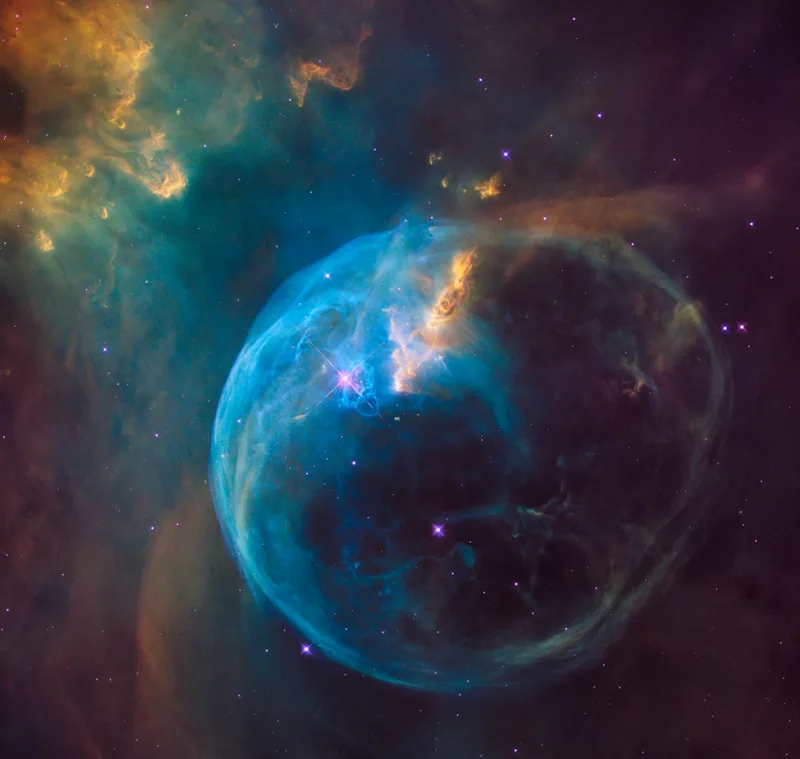
The Bubble Nebula, NGC 7635 or Caldwell 11, is an emission nebula in Cassiopeia about 7,100 light-years away. A massive young star blows a strong wind that has inflated a shell of gas around it, which appears as a near-perfect bubble in photographs. The bubble is part of a wider region of glowing hydrogen, and it lies close to the open cluster M52.
Observing tips
Find M52 by extending the line from Schedar (Alpha Cassiopeiae) through Caph (Beta) a little farther than their own separation, then move roughly half a degree southwest. Binoculars and small telescopes show the central star and perhaps a faint haze. With a 200 mm or larger telescope, a UHC or OIII filter and 80–120x, look for a faint arc curving around near the star. The full bubble is hard to see visually, so use averted vision and keep the star off-center.
Because it is faint, use a larger aperture where possible, avoid bright Moon conditions, and use averted vision.
What to expect
The central star, an O-type star many times the mass of the Sun, drives a fast wind that sweeps the surrounding gas into a thin shell. Its ultraviolet light ionizes the hydrogen, making both the shell and the wider cloud glow.
At 1,000–1,500 mm the bubble fills a useful part of the frame, while 400–600 mm captures it with M52 and the nearby nebulosity. Hydrogen-alpha and OIII together show the shell's structure well.