Observer's guide
About NGC 663
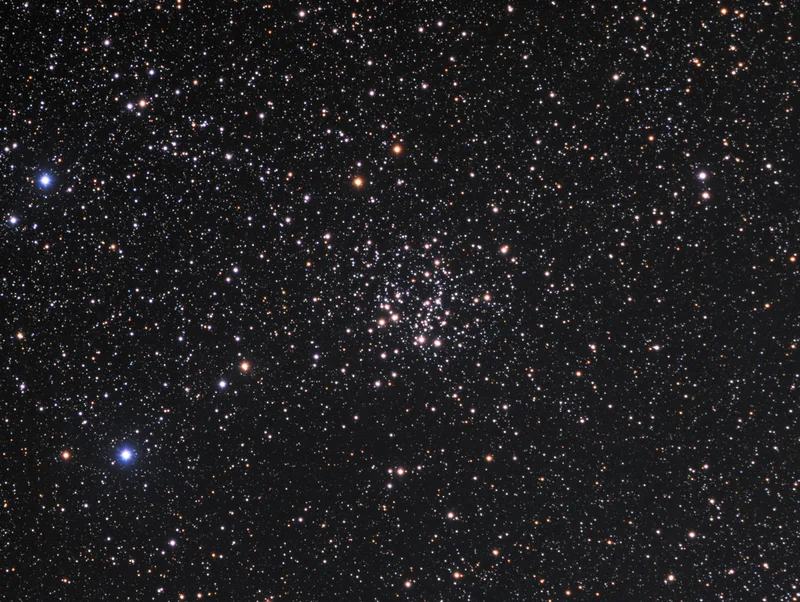
NGC 663, Caldwell 10, is one of the best open clusters in Cassiopeia, and many observers rate it above nearby M103. At magnitude 7.1 and about 18 arcminutes across, it is bright enough for binoculars and rich enough to fill a low-power telescope field. It lies about 7,200 light-years away in a busy stretch of the Milky Way, with several other clusters within a couple of degrees.
Observing tips
Look roughly midway between Delta Cassiopeiae (Ruchbah) and Epsilon Cassiopeiae (Segin); M103 lies closer to Ruchbah along the same path. Binoculars show a bright, irregular patch with a few stars resolved. A 70–100 mm scope at 40x shows dozens of stars against a hazy background. In 200 mm and larger instruments, it becomes a rich, uneven swarm that takes higher power well. Sweep the area to pick up the smaller clusters NGC 654 and NGC 659 nearby.
A small telescope under reasonably dark skies is a good starting point; use the live altitude chart to choose its highest point.
What to expect
NGC 663 is a young open cluster rich in hot B-type stars, including an unusually high number of Be stars, which show emission lines from disks of gas around them. Its stars formed together only tens of millions of years ago.
The 18 arcminute cluster frames well at 500–800 mm, while 300 mm includes M103 and the smaller nearby clusters. Short exposures keep the bright stars from bloating and preserve their colors.