Observer's guide
About NGC 4372
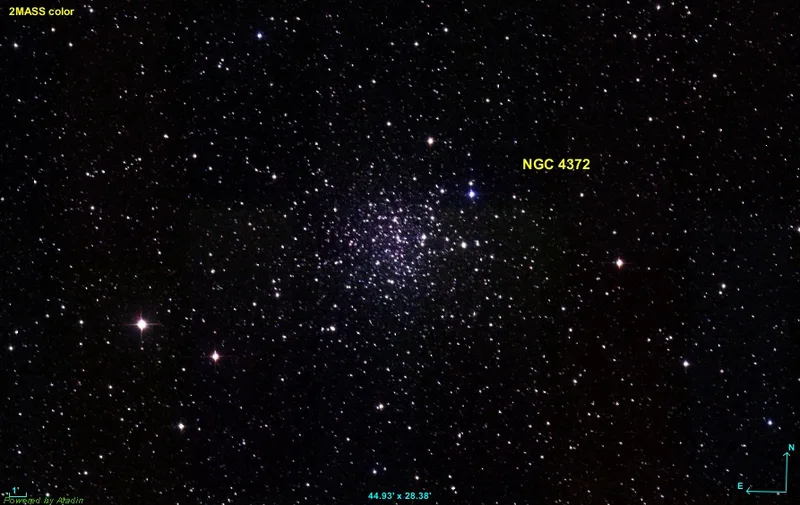
NGC 4372, Caldwell 108, is a large, loose globular cluster in Musca, about 18,900 light-years away. At magnitude 7.2 and about 24 arcminutes across, it has a low surface brightness and is partly dimmed by dust. It lies at the edge of the Dark Doodad, a long, thin dark nebula.
Observing tips
Find Gamma Muscae and look about 0.6° southwest. In binoculars the cluster shows as a faint, round glow next to Gamma. A 100 mm scope at 60x shows a large, faint haze with stars resolved across it, and a 200 mm telescope reveals a loose cluster of faint stars. Look for the Dark Doodad, a narrow dark lane running past the cluster, in binoculars or a wide-field scope. From 52°N it never rises; it is practical from about 7°N southward, best in March through May.
A small telescope under reasonably dark skies is a good starting point; use the live altitude chart to choose its highest point.
What to expect
NGC 4372 is an old, metal-poor globular cluster near the plane of the Milky Way, which explains the dust that dims its light. Its loose structure and faintness make it look different from denser globulars.
At about 24 arcminutes, 500 to 800 mm frames the cluster; 200 to 300 mm includes the Dark Doodad. Aim for long, deep exposures to show the dark nebula against the Milky Way.