Observer's guide
About NGC 4833
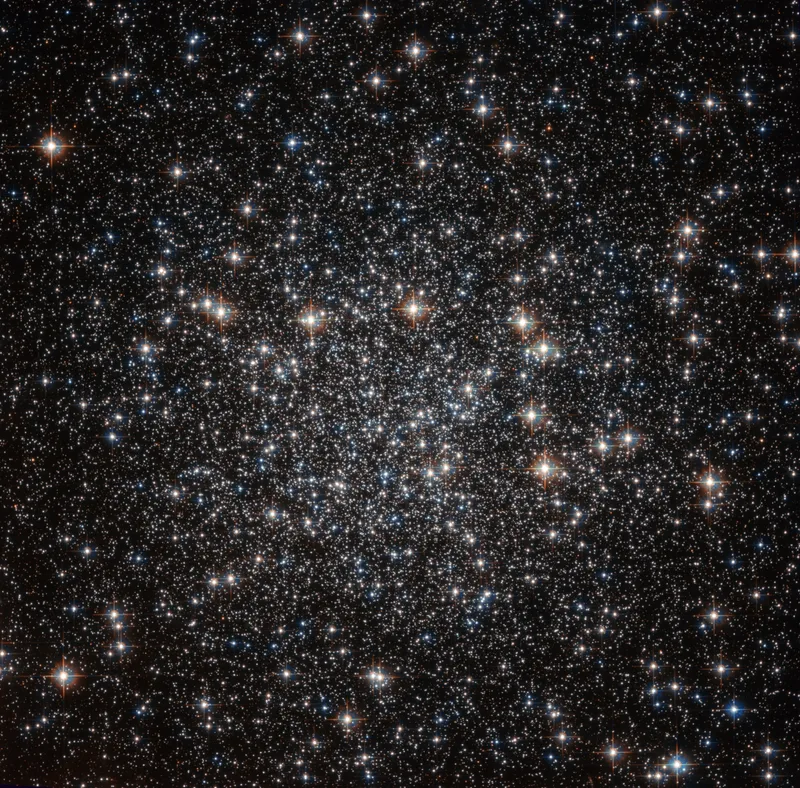
NGC 4833, Caldwell 105, is a loose globular cluster in Musca, about 19,600 light-years away. At magnitude 7.4 and about 13.5 arcminutes across, it is a fine binocular and small-telescope target. It lies close to the plane of the Milky Way, and dust dims and reddens its light, giving it a warmer tint than most globulars.
Observing tips
Find Delta Muscae and move about 0.7° north-northwest. In binoculars the cluster shows as a soft round glow. A 100 mm scope at 80x resolves many stars in the outer halo. A 200 mm telescope at 150x reveals an irregular, loosely concentrated cluster. Because of its loose structure, it resolves well even with modest aperture. From 52°N it never rises; it is practical from about 9°N southward, best in March through May.
A small telescope under reasonably dark skies is a good starting point; use the live altitude chart to choose its highest point.
What to expect
NGC 4833 is an old, metal-poor globular cluster. Its position near the galactic plane means its stars are seen through a lot of dust, which dims them and makes them look redder than they really are.
At about 13.5 arcminutes, 800 to 1200 mm suits it. Aim for accurate color correction to account for the reddening, and resolve as many stars as seeing allows.