Observer's guide
About Tarantula Nebula
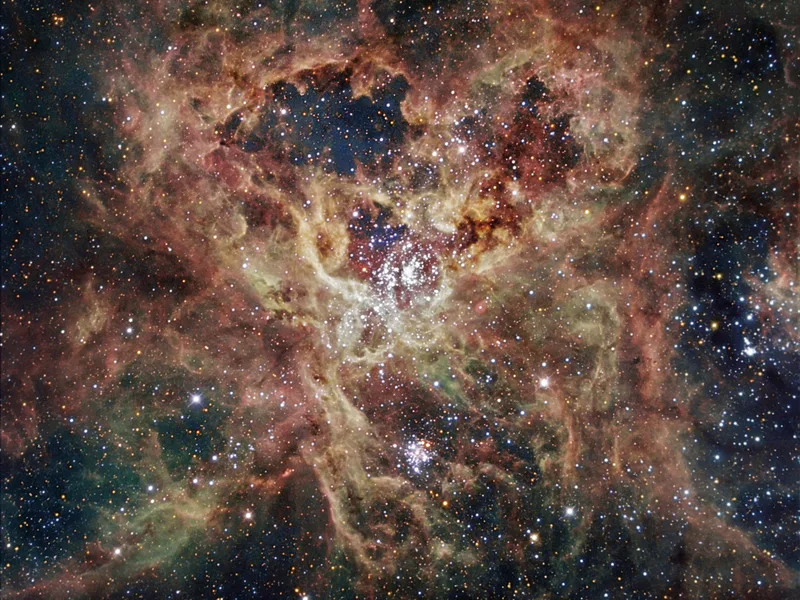
The Tarantula Nebula, NGC 2070 or Caldwell 103, is a vast emission nebula in the Large Magellanic Cloud, about 170,000 light-years away in Dorado. It is the largest and most active star-forming region in the Local Group. To the naked eye it is a bright knot in the LMC, and in telescopes its looping filaments give it the spider-like look behind its name.
Observing tips
Find the Large Magellanic Cloud, a pale cloud in Dorado, and look for a bright knot on its eastern side. Binoculars show it as a fuzzy patch with some structure. A 100 mm scope shows a looping nebula with arms radiating from a bright center, and a UHC or OIII filter adds contrast. In a 200 mm telescope its loops and dark lanes look like a spider's legs, and the central cluster R136 appears as a bright knot. From 52°N it never rises; it is practical from about 11°N southward, best in December through February.
A small telescope under reasonably dark skies is a good starting point; use the live altitude chart to choose its highest point.
What to expect
The Tarantula is lit by R136, a dense cluster that contains some of the most massive stars known. It is also the site of Supernova 1987A, the closest supernova seen since the invention of the telescope.
The bright core is compact, but the full nebula extends well beyond it, so 600 to 1000 mm frames the main structure. Narrowband data show the filaments; RGB brings out the surrounding clusters.