Observer's guide
About Lambda Centauri Nebula
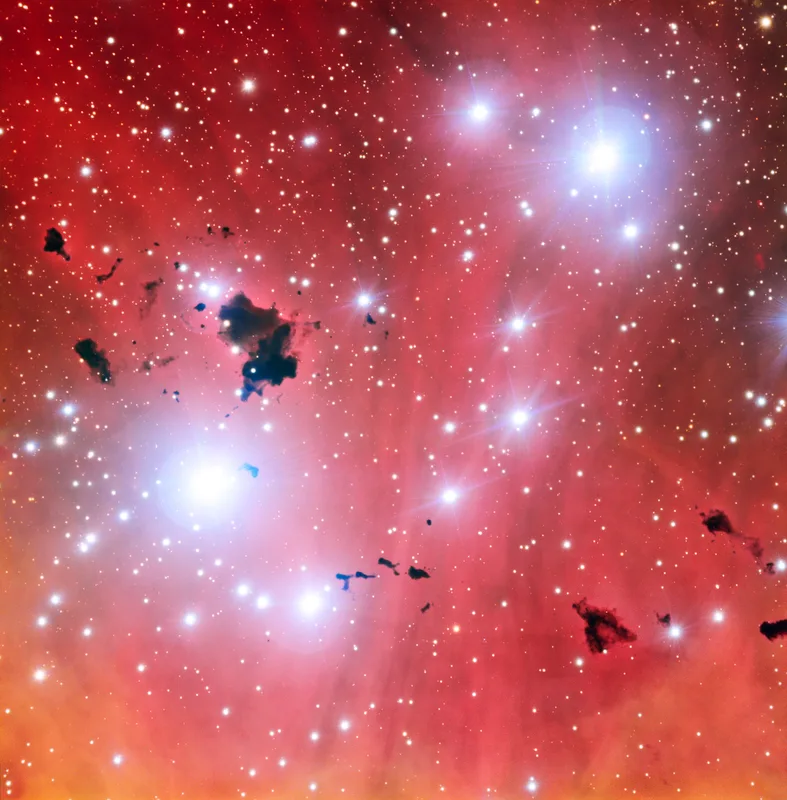
IC 2944, Caldwell 100, is an emission nebula in Centaurus around the star Lambda Centauri, about 6,000 light-years away, and is often called the Lambda Centauri Nebula or the Running Chicken Nebula. Its glowing gas is ionized by hot young stars in the associated cluster. It contains Thackeray's Globules, small dark clouds silhouetted against the bright gas.
Observing tips
The nebula lies around Lambda Centauri, about 1.4° south of NGC 3766. In binoculars the area shows a scattering of bright stars with a faint glow. A 100 mm scope at low power with a UHC or OIII filter shows a patchy nebulosity around the cluster stars. With 200 mm or more and a filter, more of the nebula's shape appears, but Thackeray's Globules remain a photographic target. From 52°N it never rises; it is practical from about 17°N southward, best in March through May.
Its brightness makes it a practical binocular or small-telescope candidate when it is well above the horizon.
What to expect
IC 2944 is a region of recent star formation, where radiation from massive stars lights up the surrounding hydrogen. Thackeray's Globules are dense clumps of gas and dust being eroded by that radiation.
The nebula spans about a degree, so 300 to 600 mm frames it well. H-alpha data reveals the red glow and dark globules; short exposures keep Lambda Centauri under control.