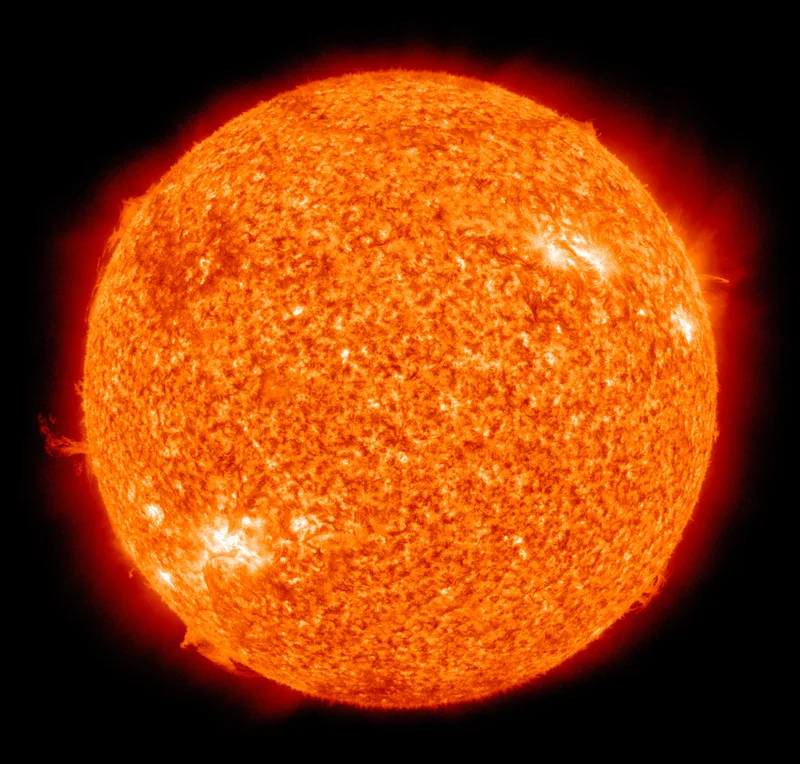
The Sun (Sol) is a G2V main-sequence star at the center of the Solar System, containing about 99.86% of its total mass. With a diameter of approximately 1.39 million kilometers and a surface temperature around 5,500°C, it emits the energy that drives Earth’s climate and makes life possible. Energy is produced through nuclear fusion in its core, where temperatures reach roughly 15 million degrees Celsius. Formed about 4.6 billion years ago, the Sun is currently in a stable phase but will eventually evolve into a red giant in about 5 billion years. Sol is approximately 1,392,680 km across.
How to observe Sol
Observe the Sun only with a certified front-aperture solar filter or a purpose-built solar telescope; unfiltered viewing can cause permanent eye damage.
Scientific context
Useful scale comparisons are 109.298 Earth diameters, 27.94 g surface gravity. These values are rounded from the catalogue measurements shown on this page.
- Radius
- 696,340 km
- Diameter
- 1,392,680 km
- Mass
- 1.989E+30 kg
- Mean density
- 1.406 g/cm³
- Surface gravity
- 274 m/s² (27.94 g)
Source: NASA Science ↗